Disclaimer: The following blog post is not a reflection of the University of Wisconsin-Madison’s opinion on the below topics.
By Talia Lunken
Disability advocacy in America can be seen as far back as 1880, with the formation of the oldest American disability self-advocacy organization, The National Association of the Deaf (NAD). NAD was founded in 1880 in Cincinnati, Ohio, to represent the community of people who were culturally deaf and focus on the education of deaf children. Few self-advocacy organizations were formed during this time, aside from those formed in response to and as extensions of state schools and other specific impairment facilities. The period after WWII was a transitional period for disability rights.[1]
For many disability rights activists, the enactment of the Americans with Disabilities Act (ADA) in 1990 was the culmination of their struggle. The purpose of the ADA was to provide a “national mandate for the elimination of discrimination against individuals with disabilities,”[2] provide enforceable standards, and ensure the government played a central role in enforcing the standards. This history has been mirrored on the University of Wisconsin-Madison campus, where the fight for accessibility and equal opportunity has continued for decades.

There are stories of blind students on campus in the 1940s who took the same classes as their siblings to not fall behind and of students recruiting sorority girls to read textbooks to them. Students had to get creative to navigate campus life. Earlier records of students with disabilities on campus cannot be found. It wouldn’t be surprising if the records were unrecorded or overlooked because of the stigma historically associated with disability.[4]
In 1967 at UW-Madison, there were only two curb cuts that were built into academic buildings that allowed access for wheelchair users. Truman J. Karabis, a wheelchair user, got the general reaction from the admission that “It’s your problem, not ours,” suggesting he should go to a flat-campus school.[5]
Around the same time, in the late 1960s and early 1970s, the disability rights movement emerged around the nation. Local disability activist groups were founded in cities and on college campuses across the United States in the 1970s. This emergence of advocacy was promoted by a series of events related to the implementation of the first major civil rights provision protecting people with disabilities, Section 504 of the Rehabilitation Act of 1973.[6]
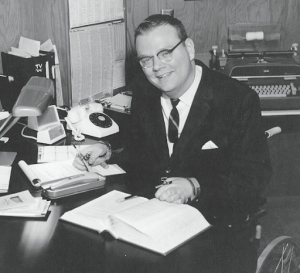 While the national disability rights movement was gaining momentum, changes began to take shape on the University of Wisconsin-Madison’s campus. The creation of resources on campus for students with disabilities was a critical part of these changes. The McBurney Disability Resource Center is now known on campus as a place that provides support for students with disabilities. The center was founded in memory of Floyd Mike McBurney (pictured right[7]) who was born in Madison, WI. He suffered a cervical spinal cord injury when he fell off a pier at the age of 16, leaving him a quadriplegic. With a severe physical disability in the 1950s, Mike faced a future of physical and social barriers. He enrolled at UW-Madison a year after the accident and met James Graaskamp, a faculty member in the School of Business and wheelchair user, through his sister. After Mike passed away in 1967, Graaskamp approached his family with the idea of using contributions that were made in his memory to start a formal disability services office on campus.[8]
The UW-Madison archives have information on the McBurney Disability Resource Center dating back to 1964. The Chancellor’s Committee for Disabled Persons comes up a lot within the collection. The committee meets to discuss projects and create subcommittees to improve campus for individuals with disabilities. Subcommittees included, but were not limited to the McBurney Resource Center Committee, Transportation for Special Needs Committee, Learning Disabilities Committee, Longe Range Planning and Evaluation Committee, and the Physical Barriers Committee.[9] The student resource center opened on April 22, 1977, in Bascom Hall rooms 75 and 77, and was named The McBurney Resource Center for Disabled Persons.[10] The 1977-1978 academic year aimed to systemize efforts to search out and resolve significant programs related to adapting the university. These efforts focused on procedures to ensure equal opportunity for all, regardless of physical impairments or learning disabilities.[11]
The McBurney Center was established in 1977 and the Chancellor’s Committee for Disabled Persons worked to make improvements in the UW-Madison campus for individuals with disabilities. Even then, there were many moments of unequal access to opportunities for individuals with disabilities. Despite the establishment of the McBurney Resource Center and other efforts to improve accessibility, by 1989 only 25% of buildings and 10% of restrooms were physically accessible. Students were still forced to fight for basic accommodations. In September of 1994, Bridget McGuire, a UW-Madison law student, took it upon herself to contest the inaccessibility of classrooms. She took a circular saw and removed a portion of her desk to make room for her wheelchair, telling fellow classmates, “I’d like to take my place among you as your classmate.”[12] Just four years before this was the enactment of the Americans with Disabilities Act of 1990, which was previously mentioned as the culmination of the struggle for many disability rights activists. However, on UW-Madison’s campus several years later, students were still dealing with discrimination in the classroom.
UW-Madison’s path to equal opportunity has been shaped by resilience, from the early struggles of students in the 1940s to grassroots efforts to establish accessible resources for students. While significant strides have been made, the history of disability rights at UW-Madison portrays that the fight for inclusion and accessibility is not over. The McBurney Disability Resource Center’s mission of “Leading the campus forward in access for students with disabilities” can serve as a reminder of the ongoing commitment to accessibility.[13]
[1]Scotch, Richard K. “‘Nothing about Us without Us’: Disability Rights in America.” OAH Magazine of History 23, no. 3 (2009): 17–22. http://www.jstor.org/stable/40505998.
[2]Ibid.
[3]Ladau, Emily. “The Americans with Disabilities Act: A Brief Background.” Disability & Philanthropy Forum, June 28, 2024. https://disabilityphilanthropy.org/resource/the-americans-with-disabilities-act-a-brief-background/.
[4]ASM Press Office Director. “Disability History at UW.” April 30, 2020. https://www.youtube.com/watch ?v=XFVxLn5QBqQ.
[5]Wathen, Emma. “Access Denied: Brigid McGuire vs. the University of Wisconsin–Madison.” Center for Campus History, April 10, 2020. https://campushistory.wisc.edu/access-denied-brigid-mcguire-vs-the -university-of-wisconsin-madison/.
[6]Scotch, Richard K. “‘Nothing about Us without Us’: Disability Rights in America.” OAH Magazine of History 23, no. 3 (2009): 17–22. http://www.jstor.org/stable/40505998.
[7]“History.” McBurney Disability Resource Center. Accessed October 10, 2024. https://mcburney.wisc.edu/about/#:~:text=After%20Mike%20died%2C%20Graaskamp%20approached,Center%20was%20founded%20in%201977.
[8]Ibid.
[9]McBurney Disability Resource Center Collection, 1964–2008, Uac222, Box 4, Chancellor’s Committee for People with Disabilities Memoranda, Reports, and Meeting Minutes, 1976–1977, Folder 10, University of Wisconsin Archives.
[10]Final Report, Chancellor’s Committee on Disabled Persons on Campus, 1976–1977, prepared by Toni Homann, WSA Student Representative, July 28, 1977. McBurney Disability Resource Center Collection, 1964–2008, Uac222, Box 4, Chancellor’s Committee for People with Disabilities Memoranda, Reports, and Meeting Minutes, 1976–1977, Folder 10, University of Wisconsin Archives.
[11]Final Report, Chancellor’s Committee for Disabled Persons on Campus, Fall 1977–June 1978. McBurney Disability Resource Center Collection, 1964–2008, Uac222, Box 4, Chancellor’s Committee for People with Disabilities Memoranda, Reports, and Meeting Minutes, 1976–1977, Folder 10, University of Wisconsin Archives.
[12]Wathen, Emma. “Access Denied: Brigid McGuire vs. the University of Wisconsin–Madison.” Center for Campus History, April 10, 2020. https://campushistory.wisc.edu/access-denied-brigid-mcguire-vs-the -university-of-wisconsin-madison/.
[13]“About.” McBurney Disability Resource Center. Accessed October 10, 2024. https://mcburney.wisc.edu/about/#:~:text=After%20Mike%20died%2C%20Graaskamp%20approached,Center%20was%20founded%20in%201977.